
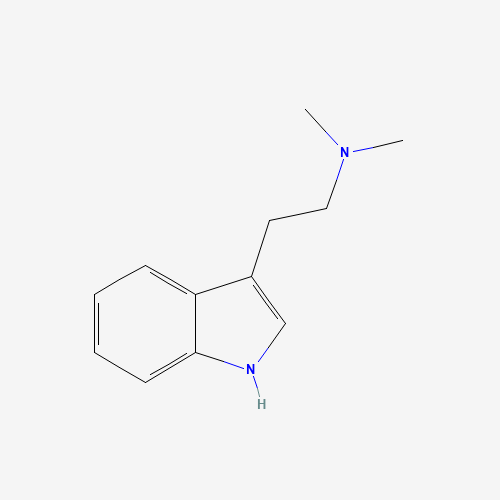
DMT
N,N-Dimethyltryptamine
Dosage
Doses below are general reference ranges, not recommendations. DMT is dosed very differently depending on the route, and the smoked and injected routes act within seconds, so it is important to be seated or lying down with a sitter before taking it. Start with a lower dose than you think you need.
Vaporized / smoked (mg)
| Level | Dose |
|---|---|
| Threshold | ~2 mg |
| Light | 10–20 mg |
| Common | 20–40 mg |
| Strong | 40–60 mg |
| Heavy | 60 mg+ |
Onset 20–40 seconds, come-up 1–3 minutes, peak 2–8 minutes, offset 1–6 minutes; total 5–20 minutes, with after-effects of 10–60 minutes.
Intravenous (clinical research): threshold ~4 mg, light 4–10 mg, common 10–15 mg, strong 15–20 mg, heavy 20 mg+; total 15–30 minutes. This route is used in clinical settings such as the Strassman studies and is not appropriate outside them.
Oral with an MAOI (ayahuasca and analogues): a DMT-containing plant providing about 35–85 mg of DMT, combined with 140–240 mg of harmala alkaloids. Onset is delayed, the MAOI is typically taken 10–50 minutes before the DMT source, and the total duration is 5–10 hours. Combining an MAOI with other drugs is dangerous — see the Harmala Alkaloids page for the full list of interactions.
Physical side effects may emerge in the days after a session. A trip sitter is recommended.
Source: PsychonautWiki (DMT).
Overview
N,N-Dimethyltryptamine (DMT) is a naturally occurring tryptamine found in hundreds of plant species, numerous animals, and — crucially — produced endogenously within the human body. It acts as a potent serotonin 5-HT2A receptor agonist and sigma-1 receptor ligand, producing one of the most intense and consistent psychedelic experiences known. When smoked or vaporized, the entire arc of a profound visionary experience unfolds and resolves within 15–20 minutes, earning it the name "the businessman's trip." Yet participants consistently report that those minutes contain more subjectively rich experience than any comparable stretch of ordinary consciousness.
History
DMT was first synthesized by Canadian chemist Richard Manske in 1931. Its psychoactive properties were discovered by Hungarian chemist Stephen Szara in 1956 when, unable to obtain LSD through official channels, he synthesized DMT from plant sources and self-administered it. Indigenous Amazonian peoples have worked with DMT-containing plants for centuries — in the form of snuffs such as yopo (Anadenanthera peregrina) and as the brew ayahuasca. When DMT is combined with a monoamine oxidase inhibitor such as harmaline (naturally present in ayahuasca's Banisteriopsis caapi vine), it becomes orally active, extending the experience to 4–6 hours. The word "ayahuasca" translates from Quechua as "vine of the soul" or "vine of the dead."

The Strassman Research
The most systematic human study of DMT was conducted by psychiatrist Rick Strassman at the University of New Mexico between 1990 and 1995 — the first government-approved psychedelic research in decades. Strassman administered approximately 400 doses of intravenous DMT to 60 volunteers, carefully documenting their experiences in real time. What emerged was a remarkably consistent landscape of phenomena. Volunteers described traveling through complex geometric realms, being received by entities — described variously as beings of light, insects, clowns, elves, or aliens — who communicated information and showed them things. Many reported feeling that they had died and entered another world. In his book "DMT: The Spirit Molecule," Strassman organized the experiences into a spectrum: from "feeling/thinking" states at lower doses, through "unseen worlds" (geometry and CEV), to "contact through the veil" (entity encounters), to "death/dying" and finally "mystical states" of pure unity at the highest doses.
The Pineal Gland Hypothesis
Strassman proposed — and the hypothesis remains controversial and unproven — that the pineal gland may be a site of endogenous DMT synthesis in humans, particularly during birth, death, near-death states, and deep meditation. The pineal has the enzymatic machinery theoretically capable of producing DMT, and its central position in the brain has made it a subject of spiritual significance across many cultures. Descartes called it "the seat of the soul." While direct evidence for pineal DMT production in living humans remains elusive, the theory has profoundly shaped both popular discourse and research directions around DMT's possible role in consciousness and dreaming.
Effects
When vaporized, onset occurs within seconds and peak intensity is reached before the user can exhale. The visual experience is immediate and total — geometric lattices, fractal patterns, and complex autonomous architecture replacing ordinary visual reality. At breakthrough doses, users report leaving the body and entering fully realized alternate dimensions populated by entities. These contact experiences have an uncanny consistency across cultures, backgrounds, and prior knowledge: the beings seem curious, communicative, and often convey that the human has arrived somewhere important. The afterglow is frequently described as a warm clarity — a sense of having glimpsed the underlying structure of reality. Ayahuasca's oral route trades intensity for duration and depth of emotional and visionary content, and is typically guided by a trained ayahuascero or curandero.
- Intense pressure at onset
- Physical euphoria
- Pupil dilation
- Rapid heart rate
- Rapid breathing
- Tactile enhancement
- Motor control impairment
- Full physical incapacitation (breakthrough)
- Kaleidoscopic geometry
- Fractal architecture
- Full visual replacement (breakthrough)
- Entity encounters
- Alternate realms / landscapes
- Colour shifting
- Environmental morphing
- Machine-like structures
- Ego dissolution
- Consciousness expansion
- Time distortion (extreme)
- Sense of timelessness
- Entity communication
- Déjà vu
- Thought acceleration
- Profound meaningfulness
- High-frequency carrier tones
- Auditory hallucinations
- Tonal shifting
- Auditory enhancement
Research
Current research explores DMT's therapeutic potential and its role in consciousness science. The sigma-1 receptor — activated by DMT — regulates neuroplasticity, neuroprotection, and cellular stress responses, suggesting DMT may have physiological roles beyond pure psychedelic activity. Clinical research into ayahuasca has shown significant promise for depression, PTSD, and addiction. A 2018 study in Scientific Reports found that ayahuasca produced rapid antidepressant effects, with scores on depression rating scales dropping significantly within days of a single session. The Imperial College London has an active program studying extended-state DMT (infusion rather than bolus dose), allowing researchers to study the sustained DMT state in real time.
Legal Status
DMT is classified as a Schedule I controlled substance under US federal law. Ann Arbor decriminalized natural psychedelics in 2020. Ayahuasca use by certain religious organizations — specifically the União do Vegetal (UDV) and Santo Daime — has received federal legal protection in the United States under the Religious Freedom Restoration Act, following Supreme Court precedent (Gonzales v. O Centro, 2006). In several South American countries, ayahuasca is legal and openly practiced.
Harm Reduction
Due to its overwhelming intensity, smoked DMT should never be used alone. A trusted, sober sitter is essential — motor control is significantly impaired during the experience. The most common risk is physical injury from falling or dropping a lit pipe. Do not combine with MAOIs unless intentionally preparing an ayahuasca analog, and only then with complete dietary compliance (tyramine-free diet). For ayahuasca ceremonies, working with an experienced, vetted facilitator is strongly recommended — the emotional and psychological material that surfaces can be intense and requires skillful support. Those with cardiovascular conditions, personal or family history of psychosis, or currently taking SSRIs or lithium should avoid DMT.
This page is for educational purposes only. Nothing here constitutes legal, medical, or therapeutic advice. Know your local laws.